 Museum of Talking
Boards
Museum of Talking
Boards
Gallery of Talking Boards
Page Two
Museum of Talking
Boards
|
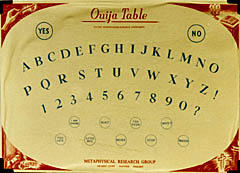
OUIJA TABLE Metaphysical Research Group Design on paper-cardboard 1960's Covered in heavy plastic and secured in the corners with metal clasps, this talking board from Hastings, England is designed to stand up to the most rigorous punishment. It was popularized in the video by Steven Patrick Morrissey. The small print under the words Ouija Table identifies it as a Psychic Investigators' Research Instrument. |
|
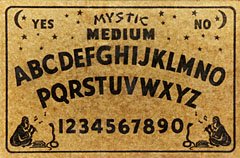
MYSTIC MEDIUM Medalie Manufacturing Company Design on hardboard Snake charmers never looked better than on this Mystic Medium board. On the reverse side is a checker board to use if the spirits aren't biting. |
|
|
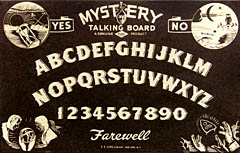
MYSTERY TALKING BOARD E.S. Lowe Design on hardboard 1940's We love the design of this board from E. S. Lowe with the hourglass, owl and moon, crystal gazers, and the hands reaching for the glowing planchette. |
|
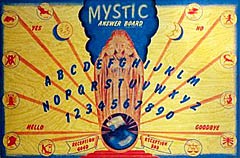
MYSTIC ANSWER BOARD Remington - Morse Design on paper-hardboard 1944 The picture doesn't do this Mystic Answer board justice with its beautiful red, beige, and blue hues. |
|
|
BLACK MAGIC TALKING
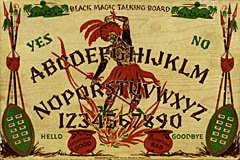
BOARD Gift Craft Design on paper-hardboard 1940's This time it's jungle magic from Gift Craft with a witch doctor and his weapons. We're afraid to guess what he may be cooking up in those kettles. Maybe he's a cannibal. Why else would those letters be in the shape of human bones? |
|
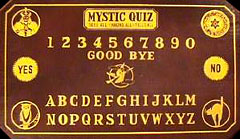
MYSTIC QUIZ Shackman Design on wood Yep, that's a witch with a broomstick on this classic Halloween talking board. Also notice the owl and the cat. All that's missing is the Devil. Perhaps the Mystic (upper left corner) qualifies. A black version of the Mystic Quiz was also available. This is one of the smallest talking boards measuring only 7 by 12 inches. |
|
|
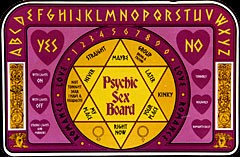
PSYCHIC SEX BOARD American Publishing Design on paper-hardboard 1979 Act out your fantasies with this shocking pink pre-AIDS era sex board. Be "kinky, straight, or bring a friend" depending where the planchette "points." If you are not "up" to it, never fear, you can land on "not tonight dear, I have a headache." |
|
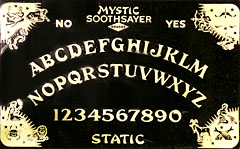
MYSTIC SOOTHSAYER WM. F. Drueke & Sons Design on hardboard 1944 The instructions for this "Midnight" Mystic Soothsayer warn you not to confuse it by asking more than one question at a time. Good advice, it seems to us. For those of you who like to operate talking boards in a closet with a friend, this was a glow-in-the-dark board. Not sure what they used to make it glow. Just don't keep it next to your body for long periods. |
|
|
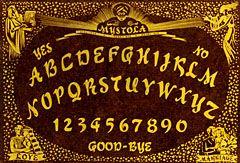
MYSTOLA Crestcraft Company Design on hardboard 1940's Nothing risqué about this pretty board designed for the romantic in everyone. The Scribe and the Harpist (upper corners) know our destiny. Love and marriage (lower corners) awaits. This is THE board you want to take to your girlfriend's house. |
|
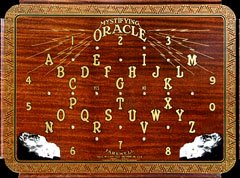
MYSTIFYING ORACLE William Fuld Design on metal 1930's Could this be the "Holy Grail" of Ouija boards? If it isn't the rarest of all William Fuld boards then it certainly is ahead of whatever is in second place. Read more about this odd metal Mystifying Oracle with the weird battery operated light-up planchette on our Electric Mystifying Oracle page. |
|
|
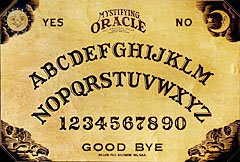
MYSTIFYING ORACLE William Fuld Design on wood 1940's Depending on what you wanted to spend, you could have the paper covered hardboard model or the more expensive all wood bird's eye maple deluxe Mystifying Oracle pictured here. Large and small versions were available in the paper versions. |
|
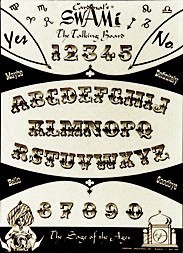
CARDINAL'S SWAMI Cardinal Industries, Inc. Design on paper-hardboard 1940's This Cardinal Industries Swami Sage of the Ages is a real standout, not only for the superb letter and number placement, but for the wonderfully detailed Victorian circus style alphabet. Notice that this board is taller than it is wide, another rarity. Each Swami Sage of the Ages came with it's own special Swami hand to make sure you were pointed in the right direction. Here it is below: 
|
|
|
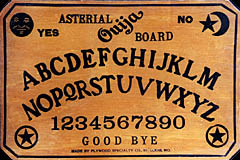
ASTERIAL OUIJA BOARD Plywood Specialty Company Design on wood Asterial means "having to do with the stars." That must distinguish it from that other "Ouija" that it copies exactly, namely William Fuld's. |
|
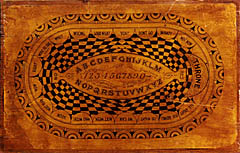
THRONE BOARD J.E. Garside Design on paper-wood 1893 We call it the throne board for want of a better title. The throne faces a round table, King Arthur style. Letters, numbers, and word quick picks allow you to make those royal decisions. Patented by J.E. Garside August 8, 1893. |
|
|
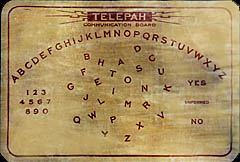
TELEPAH BOARD Psychic Research Ass'n Design on wood Looks like someone spilled alphabet soup right in the center of this board from Salem, MA. Instructions on the back claim that the Telepah is "a medium for the purpose of thought transference or materialization, and is believed to be one of the most successful and practical instruments for this purpose." |
|
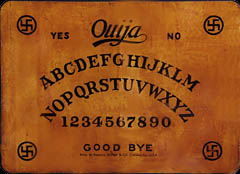
OUIJA Russell Rucker & CO Design on wood This is one of several boards we have seen besides the Simmons Ouija, to feature swastikas. Although there is no date, we are very sure that it is pre-1940's. |
|
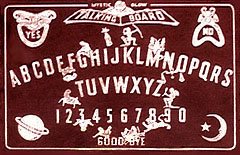
|
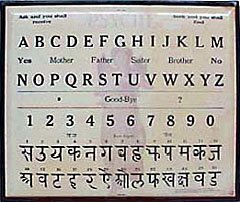
MYSTIC GLOW Manufacturer Unknown Design on paper-hardboard We don't know quite what to make of this board with the creepy fun-house images. Contrast this cheap dime store board with the serious seance instrument in the frame below. It's all about intent, of course. The intention of making a dollar versus the intent of contacting the spirits. |
|
PSYCHE Psyche Publishing Co. Design on tin-plastic 1921 Let Psyche be your muse with this interesting board reminiscent of the earlier Wireless=Messenger. Psyche Publishing produced much material for the devoted psychic researcher. This board was their number one seller. |
|
|
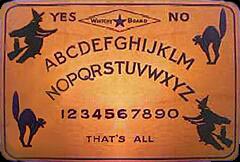
WHITCHY BOARD J.W. Stanley Design on wood 1920 One wonders if they didn't know how to spell "Witchy" or if they just didn't give a whit. Anyway, this is a wonderful example of a Halloween board. That's an owl sitting on the broomstick with the "whitch." All we need now is a "phumpkin." |
|
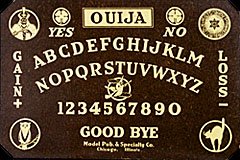
OUIJA Model Pub & Specialty Co. Design on hardboard Here's a large version of Shackman's Mystic Quiz renamed "Ouija." Or is it the other way around? Interesting how two companies can market the same design with minor variations. We see this a lot in the talking board business. |
|
|
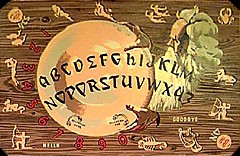
FATHER TIME Advance Games Co. Design on paper-hardboard 1945 Father Time tells all, presumably after looking into his huge crystal ball. The headphones floating in the crystal are labeled "Conditions Good" and "Conditions Bad" just to let you know Father Time's current temperament. The Father Time Talking Board was made in Canada and in the US. |
|
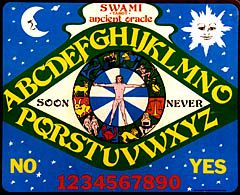
SWAMI Pyramid Power V Inc. Design on paper-hardboard 1977 It's the Age of Aquarius again with this seventies Swami Tarot Ancient Oracle. Use it like a conventional talking board or flip it over and consult the tarot cards on the back. Great period design. |
|
|
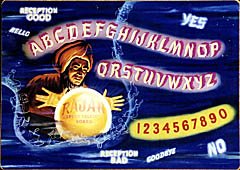
RAJAH Clinton Art Products Design on paper-hardboard 1944 If you get bored with your collection of plain wood talking boards this gorgeous Rajah Spirit Talking Board is sure to brighten your afternoon. This is one of the nicer ones. |
|
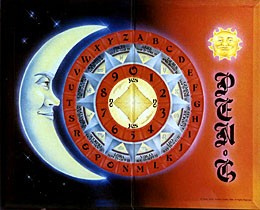
PEN-G Corneau Karas Ltd. Design on paper-cardboard 1984 The folding Pen-G has to be one of the prettiest talking boards with its colorful design and delicate shading. Originally a pendulum board, it works much better with a planchette. The moon and the sun agree. Or is that just our imagination? |
|
|
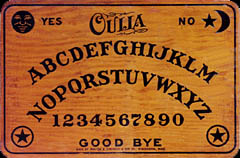
OUIJA Morton E. Converse & Son Design on wood First prize for the all time best Ouija clone goes to this Fuld facsimile on the left. Kind of makes you wonder what else Morton & Son copied, doesn't it? The message indicator is stamped with a bold "Converse Mark of Quality" logo. |
|
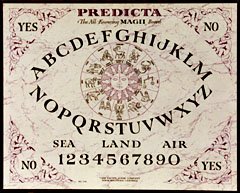
PREDICTA Pacific game Company Design on paper-hardboard 1968 The Predicta All Knowing Magii Board came in the lap version (shown here) and the deluxe "tablette" model with non-skid wooden feet for table top use. The planchette for this board had a grommet in the center for a pencil, in case you wanted to use it as an automatic writer when "you were ready for more advanced communication." |
|
|
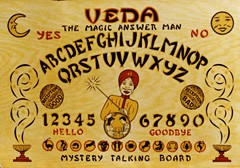
VEDA Wiz Novelty Co. Design on paper-hardboard 1940 According to the instructions, Veda is endowed with many centuries of wisdom and knowledge and will answer all your questions of the past, present and future. A companion Veda the Magic Answer Man game was also available from Wiz Novelty Company. |
|
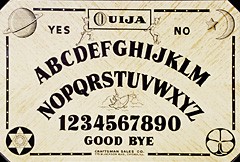
OUIJA Craftsman Sales Co. Design on cardboard 1943 This is a Lee board sold by Craftsman Sales Company. C.O.D. to you for $1.80. That was in 1943. Wonder what it would go for on eBay these days? It came with the board, box, "Supertable" (assembly required), directions for the Mysterious Talking Board, and your Astrological Forecast—a thirty page booklet. That's a pretty good deal for $1.80, don't you think? |
|
|
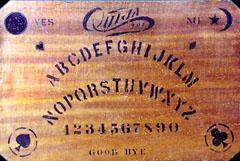
QUIJA Southern Toy Company Design on wood 1919 Did Isaac Fuld intentionally misspell Ouija with a "Q" or is that just a ribbon flourish? This very rare board, unlike his Oriole, has more of a fortune telling design with the playing card pips. The PPF in the logo stands for Past-Present-Future, a common phrase found on other fortune telling games of the era. See the original stencil for this board at William Fuld.com. |
|
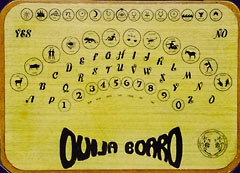
OUIJA BOARD Manufacturer Unknown Design on paper-hardboard This inexpensive import from Taiwan has the Zodiac and a variety of other planetary symbols sprinkled about the board. Below the numbers are the days of the week. The circle in the lower right hand corner reads: Planchette Trade Mark Ouija Board Pat Pen, whatever that means. |
|
|
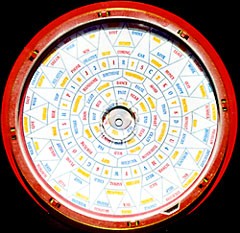
FICKLE FINGER OF FATE Mego Corp. Design on plastic 1979 And now for something completely different. You fill the flat sphere with water and add a small floaty finger. A magic substance called "Slik Silver" takes over and the floaty finger spells out your messages. We kid you not. It didn't work very well for us but that's because (we presume) it's fickle. |
|
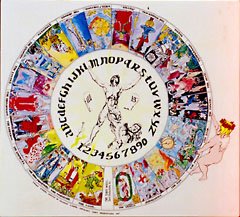
TAROT WHEEL Tarot Productions Design on paper-hardboard 1967 Pretty Age of Aquarius 60's symbolism board by tarot artist Frankie Albano. You can't see it because the picture is too small, but that's a hookah right next to the "A" on the board. Judging from the skyward glance of the hippie in the middle, we would venture to say he looks pretty stoned. He is also naked. A lion head hides his private parts. Don't try that at home and don't ask us about the Cherub holding the wheel. We haven't a clue. |
|
|
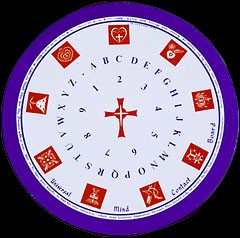
UNIVERSAL MIND CONTACT Joseph R. Myers Design on paper-hardboard 1968 Loaded with chalices, doves, and crosses, this board was obviously designed by a member of the Catholic Church. Even the message indicator is in the shape of a cross. The directions state that the board is specifically designed to get you in contact with the Saints and the Angels. Prayers of supplication are included to insure that you don't run afoul of the Big Guy. |
|
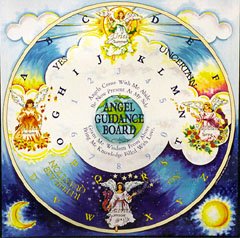
ANGEL GUIDANCE BOARD J & J Inspirations Design on paper-hardboard 1995 This is one of the prettier angel boards. Four angels float around the Earth in a very protective way. Should you be at a loss as to how to start your session don't worry, an opening prayer is printed right on the board: - Angels come with me abide - Be now present at my side - Grant me wisdom from above - Bring me knowledge filled with love. |
|
|
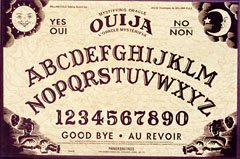
OUIJA Hasbro Canada Inc. Design on paper-hardboard 1995 What did a Parker Brothers Ouija board Canadian style look like? It looked like this board on the left. Ouija L'Oracle Mysterieux was the jeu de messages de William Fuld. Get it? Well, au revoir then. |
|
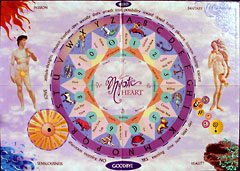
MYSTIC HEART Relationship Enrichment Systems Design on paper-cardboard 1999 Only just recently extinct, this talking board was more for two people in-the-mood than those who wanted to conjure spirits. It had the Zodiac, Venus and David plus a question wheel with a spinner in case you were too drunk to remember your question. The message indicator was, as you might expect, heart shaped. |
|
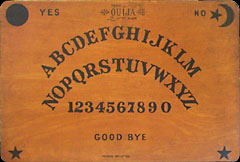
|
OUIJA Copp Clark Company Design on wood 1892 Elijah J. Bond assigned his Ouija board rights to Kennard Novelty Company for US distribution and to International Novelty Company for Canadian sales. On June 15, 1892, International Novelty signed a contract with Copp Clark Canada to make Ouija boards for a license fee of twenty-five cents each. It is unknown how long this agreement lasted. Copp Clark continued to make the boards for decades. Compare the Ouija logo on this board with the Kennard design at Gallery Page One. |
|
NIRVANA Swastika Novelty Company Design on wood 1907 Perhaps Bond figured that he had missed the boat by losing out so quickly. In any event, he produced the Nirvana from the Swastika Novelty Company in West Virginia for a short time. It is one of the rarest of all boards. Known as Bond's "other Ouija board," collectors thought it to be extinct until recently. |
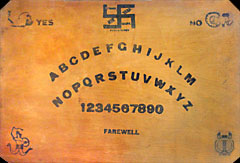
|
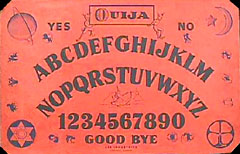
|
OUIJA Lee Industries Design on cardboard 1940s This is Lee Industries' version of the Craftsman Sales Ouija on Gallery Page Seven. Lee made several of these boards under different names and companies. Apparently there was no conflict using William Fuld's Ouija Trademark. Or if there was, the Fuld's legal representation was wanting. There were Ouijas everywhere during this time. |
|
SPHINX ORACLE BOARD Cowan Products Design on hardboard Sphinxes, pyramids, and signs of the zodiac adorn this oddball, squarish talking board from Cowan, NY. The Sphinx shows up on eBay several times a year. How rare is that? Well, there aren't any in your town and maybe not in your state. Does that make it rare? |
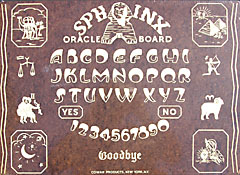
|
|
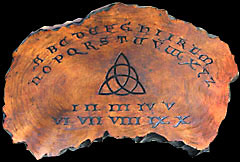
CHARMED SPIRIT BOARD Sota Toys Design on cold cast resin 2006 Dubbed the "Charmed cowpie" by those frustrated with production delays and by the look of the final product, the Charmed Spirit Board sold out almost immediately. This may have had more to do with worldwide distribution than with the fans of the TV show. Sota called the board an "exact replica" which was not quite accurate. See for yourself at our Spirit Board page. Despite the problems, this was a fine acquisition for any collector, fan of Charmed, or not. |
|
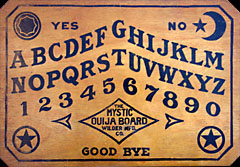
MYSTIC OUIJA BOARD Wilder Manufacturing Company Design on wood 1920s Is that the MITCHE MANITOU with a different name? Why yes, I believe it is. We don't know which came first, the Mitche Manitou or the Mystic Ouija Board. Some have suggested that the William Fuld Company may have intervened. That may very well have happened. We've heard that they were more litigious in the 1920s. |
|
|
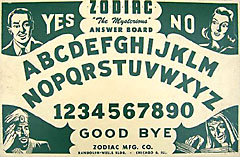
ZODIAC Zodiac Manufacturing Company Design on hardboard 1940's This Zodiac looks like the Mysterious Planchette on Gallery Page One. They even have the same address: Wells building, Chicago. Let's see: the Zodiac Manufacturing Company made the Zodiac and the Planchette Company made the Mysterious Planchette. I think I'm beginning to see how these things worked. How about you? |
|
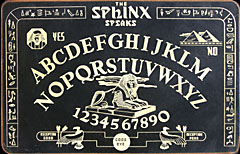
THE SPHINX SPEAKS Jerry Lowenthal and Co. Design on hardboard The Sphinx Speaks is an intense white on black Egyptian themed talking board that looks much better full-size. We looked for years, missed several on eBay, and then found one at a swap meet. Goes to show you: when the Sphinx Speaks, the Sphinx Speaks at the swap meet. Or, something like that. We're guessing that this is a 40s board. There was no date on the box. |
|
|
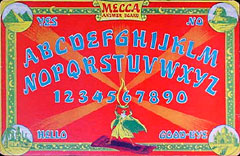
MECCA ANSWER BOARD Lee Industries Design on paper-cardboard 1940's As far as color intensity, this outshines the Hindu Oracle below. In fact, it's a little hard to look at without causing eyestrain. Maybe it works better with just one candle. The planchette resembles Aladdin's lamp and the directions implore you to "point the spout at the letters." That's good advice. |
|
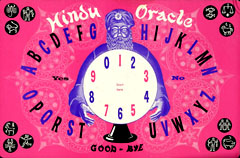
HINDU ORACLE Winston Sales Design on paper-hardboard 1960's Not satisfied to be simply a talking board, the Hindu Oracle came with an astrology book, the Gypsy Witch Fortune Teller, and twenty-five extra sensory perception cards. Now that's bargain for your buck. Complete instructions on the back of the box explained everything in detail so that you could decide if it was right for you. |
|
|
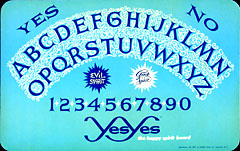
YES YES Corr Dis Inc Design on paper-cardboard 1971 Goofy is the only word we have to describe this bright blue talking board. "Will not tell fortunes," proclaims the box in case you might be misled. Actually, the box is more interesting than the board with its images of good and evil spirits—all from the seventies. The board has a sponge rubber backing so that it will stay firmly rooted to your lap. If the board falls to the floor, an evil spirit may get loose, don't you know. |
|
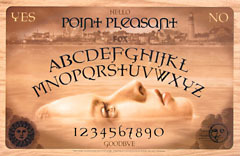
POINT PLEASANT Twentieth Century Fox Film Corp Design on paper-cardboard 2005 Fox pulled the TV soap drama Point Pleasant after only three months and it's no wonder. The Devil's daughter washes up on the shore of Point Pleasant, New Jersey and causes havoc with the townsfolk. How real or entertaining is that? Not very, according to the low ratings. One good thing was this promo talking board. That's the Devil's daughter staring skyward if you were wondering. |
|